
Forensic STRs
STRs are short DNA sequences repeated in tandem. The allele number reflects how many times the sequence repeats, with decimals indicating partial repeats (e.g., 9.2). Understanding this is key to interpreting forensic STR profiles.
Forensic STRs
What is an STR?
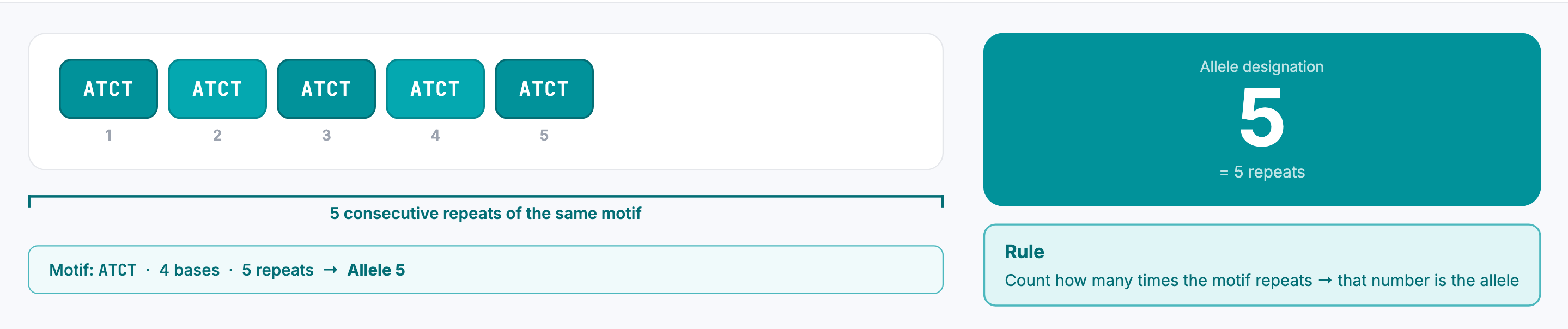
Short Tandem Repeats (STRs) are regions of DNA where a short sequence of bases is repeated multiple times in a row.
Example:
ATCT ATCT ATCT ATCT ATCT
In this sequence:
- The same pattern (ATCT) appears repeatedly
- Each block has 4 bases
- The block is repeated 5 times consecutively
How to interpret an STR sequence
To determine the allele, you need to answer “how many times is the same sequence repeated?” That number defines the allele.
Example
ATCT ATCT ATCT ATCT ATCT ATCT ATCT ATCT ATCT ATCT
The same sequence appears 10 times. Allele designation = 10
Quick notation
For users already familiar with STR terminology:
Motif = ATCT
Repeat count = 5
Allele = 5
This is the standard way to summarize the same information.
When the sequence is not a full repeat
Some alleles include an incomplete repeat at the end.
Example:
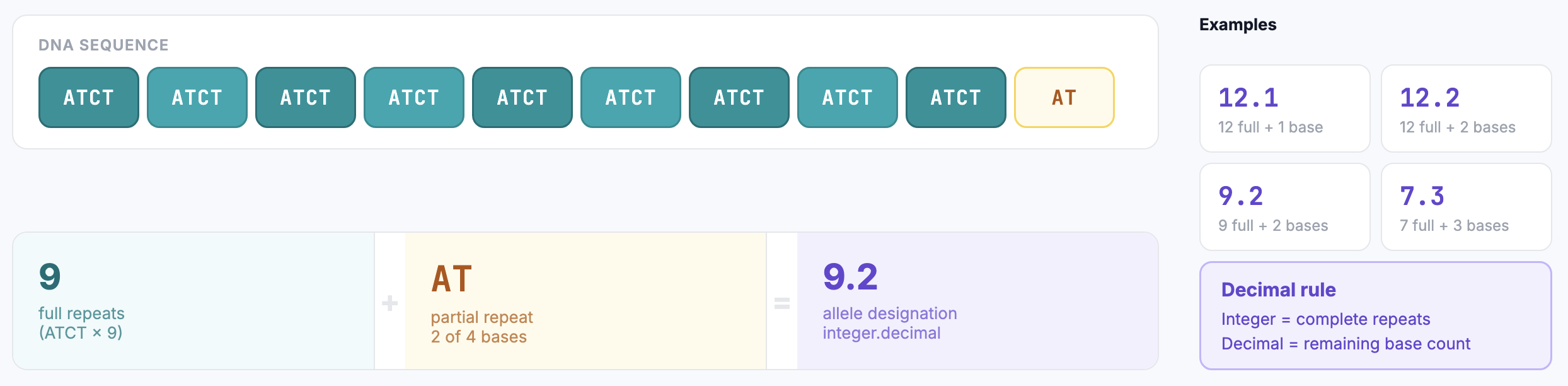
ATCT ATCT ATCT ATCT ATCT ATCT ATCT ATCT ATCT AT
- Full repeats: 9
- Remaining bases: AT (2 bases of a 4-base motif)
Allele designation = 9.2
How to read decimal alleles
- Integer = complete repeats
- Decimal = partial repeat
Examples:
- 12.1 → 1 base of an incomplete repeat
- 12.2 → 2 bases of an incomplete repeat
STR analysis in forensic practice (CE overview)
In forensic laboratories, STRs are commonly analyzed using Capillary Electrophoresis (CE).
- DNA fragments are amplified using PCR
- The size of each fragment is measured
- The allele is inferred from fragment length
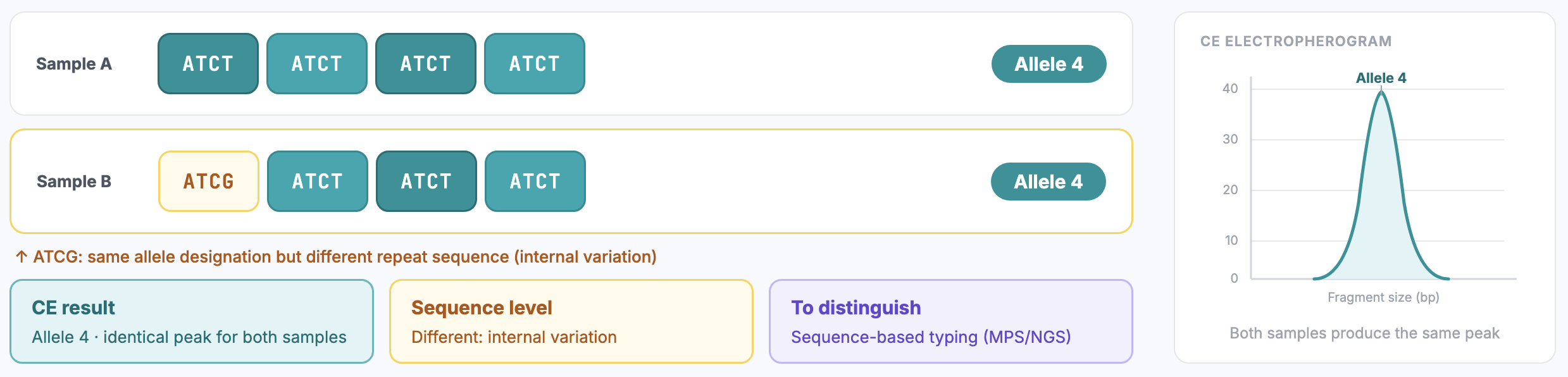
Important: CE provides fragment size, not the underlying DNA sequence.
This means:
- The allele number reflects length
- Internal sequence variation is not observed
Sequence-level variation (brief note)
Different DNA sequences can produce the same allele number if they have the same length.
These are known as isoalleles.
- Same allele designation
- Different underlying sequence
(This is explored further in sequence-based STR analysis modules)
Summary
- STRs are repeated DNA sequences
- The allele corresponds to the number of repeats
- Partial repeats are represented with decimals (e.g., 9.2)
- CE measures fragment size, not sequence
- Identical allele sizes may differ at the sequence level